Changing Places, Small World and Nice Work, by David Lodge are comic novels that I thoroughly enjoyed though at thirty years distance I couldn't tell you much about them, nor could I name a single other novel by him.
Now he's written an autobiography so I thought it would be interesting to hear him and it was. The event was in the form of an interview although he did read from the book, or as he explained an edited composite covering his relationship with Malcolm Bradbury and his fascination with America, these being two topics suggested by his interviewer.
It was a very enjoyable session and I'm now encouraged to add some of his other work to the big pile of books to be read that is building up on my shelves and in my head.
It was also a great relief after the well nigh unbearable session I went to yesterday. I didn't bear it in fact, see later.
This was about The Wake, a novel set in the Fens in the years following the Battle of Hastings. The author filled in historical detail in a jokey 1066 and All That manner - "William was a little put out so he had them boiled in oil and then went home for his tea" sort of thing, interspersed with readings from the book by the now renowned actor Mark Rylance and a related folky story told to the beat of his bodrum by a chap called Martin Shaw.
Rylance dressed in combat trousers and a funny hat intoned the cod Anglo-Saxon ( sorry the publicity calls it contemporary Anglo-Saxon whatever that means) tale of guerrilla warfare against the Normans. Shaw in another funny hat tells a story about a child, later man, with golden hair who is clearly Hereward The Wake. The publicity tells us the story has not been told aloud for a thousand years and I can believe it.
The session was scheduled to last an hour and a half but as time wore on I thought how long that was and more and more about escape. Being in the middle of a row I was reluctant to make a move. At the ninety minute mark there was no sign of our being near a conclusion and I grew even more restive. Happily the lady next to me had also had enough, or maybe she just had to get somewhere, so I slipped or in fact clattered (the wooden stairs!) out under her cover.
But The Guardian, and no doubt others, loved the book, "A Literary Triumph". Maybe it just suffered from its presentation and I should give it a try. Maybe.
I thought Antigone, which I went to after that, also suffered from its presentation. Not the staging and so forth. That was fine although the upper level should have been higher or raked towards the back to minimise the masking that occurred.
No, it's the acting style that I didn't much care for. Now this is not a wee domestic drama. It's all about obedience to the law, the rights of rulers, loyalty to the state, a greater power than the king etc. etc. so a serious not to say grim approach to the representation of the characters caught up in the situation is not surprising. But at the same time these are people and it is their feelings as much as their ideas that should come over to the audience and for me at least that didn't happen.
Sunday, August 23, 2015

Friday, August 21, 2015
In 1914 over 80% of the world was or had been under the control of European powers (many territories had subsequently wrestled free) despite the fact that a thousand years earlier China, Japan, and the Middle East were streets ahead of Europe by any measure of development or civilization.
How come? Well says Philip T Hoffman, although the Chinese invented gunpowder the Europeans developed and improved the weapons that it fed and practiced using them by fighting amongst themselves, paying for their wars by levying large taxes on their populations. As a result he says they were well equipped to set out to conquer the world while those other civilizations remained inward looking and left the citizenry with more of their own money. Tory regimes surely.
The Telegraph's reviewer is not wholly convinced but gives Hoffman's book, Why Did Europe Conquer the World, four stars. I enjoyed his talk but I doubt I'll ever get round to reading his book.
The packed Playhouse gave a rapturous reception to Seven last night but I found it an unsatisfactory watch and listen. My fault I'm sure. I should perhaps, as recommended in this review , have let it all wash over me instead of trying to fathom what it might have been telling me.
My sympathies were with the lady I overheard at the Book Festival this morning telling her friend that she would rather have heard the RSNO playing Mahler in the Usher Hall and complaining about low lighting and black costumes on a black set.
It was all bright colours at the talk about translating children's books into English from Farsi and Arabic. One of the contributors spoke mostly in Farsi and as seems often to be the case said rather more than the poor chap interpreting had managed to retain when she paused for breath.
But the languages were not very important really. It was a discussion that could have applied to any language pair and they talked about dealing with cultural differences and maintaining the essence of a story while expressing it in words far removed from a literal translation.
The chat strayed from time to time into the realms of adult literature, Fitzgerald and the Rubaiyat being an obvious reference. I could have piped up then about my Scots version but instead asked about the availability of western children's literature in Iran.
There is quite a lot of it apparently but it's all bootleg translations because Iran doesn't observe international rules on copyright. So thing haven't improved since I picked up a pirate cassette of Glen Campbell in Tehran in 1978 just a year before the revolution.
How come? Well says Philip T Hoffman, although the Chinese invented gunpowder the Europeans developed and improved the weapons that it fed and practiced using them by fighting amongst themselves, paying for their wars by levying large taxes on their populations. As a result he says they were well equipped to set out to conquer the world while those other civilizations remained inward looking and left the citizenry with more of their own money. Tory regimes surely.
The Telegraph's reviewer is not wholly convinced but gives Hoffman's book, Why Did Europe Conquer the World, four stars. I enjoyed his talk but I doubt I'll ever get round to reading his book.
The packed Playhouse gave a rapturous reception to Seven last night but I found it an unsatisfactory watch and listen. My fault I'm sure. I should perhaps, as recommended in this review , have let it all wash over me instead of trying to fathom what it might have been telling me.
My sympathies were with the lady I overheard at the Book Festival this morning telling her friend that she would rather have heard the RSNO playing Mahler in the Usher Hall and complaining about low lighting and black costumes on a black set.
It was all bright colours at the talk about translating children's books into English from Farsi and Arabic. One of the contributors spoke mostly in Farsi and as seems often to be the case said rather more than the poor chap interpreting had managed to retain when she paused for breath.
But the languages were not very important really. It was a discussion that could have applied to any language pair and they talked about dealing with cultural differences and maintaining the essence of a story while expressing it in words far removed from a literal translation.
The chat strayed from time to time into the realms of adult literature, Fitzgerald and the Rubaiyat being an obvious reference. I could have piped up then about my Scots version but instead asked about the availability of western children's literature in Iran.
There is quite a lot of it apparently but it's all bootleg translations because Iran doesn't observe international rules on copyright. So thing haven't improved since I picked up a pirate cassette of Glen Campbell in Tehran in 1978 just a year before the revolution.
Thursday, August 20, 2015
Ferdinand Mount, one-time policy chief in Mrs Thatcher's Downing St., like many a posh sounding Eton and Oxford Englishman turns out to have some good Scotch blood running through his veins and has written a book about the people who put it there.
His great-great-grandfather (whom he shares with David Cameron) was John Low of Clatto in Fife who at the age of 16 went off to join the East India Company and retired after a lifetime of service to the Empire as General Sir John Low, earning in his later years the privilege of going round the Old Course on the back of a pony. The earliest golf buggy known I imagine.
The Tears of the Rajas: Mutiny, Money and Marriage in India 1805-1905 tells the fascinating story of the Low family's lives both personal and political over that century. It's a story that is both romantic and brutal and Mount's talk had me gripped from start to finish.
There were stacks of copies of the book in Charlotte Square at £25 a pop but happily it's also available on-line in a substantially cheaper paperback edition provided you don't mind waiting till February. I don't.
The novel Nora Webster that Colm Toibin was in Edinburgh to talk about is already out in paperback and most of the people in the audience had probably read it. Those who asked questions certainly had. According to The Guardian "This personal portrait of grief and politics in 1960s County Wexford does everything a great novel should". I expect that is something along the Reithian lines of inform, educate, entertain. I bought a copy so I'll let you know in due course.
Macbeth opens with the line "When shall we three meet again". Youth Music Theatre UK keep the line but multiply the number of witches by three and not content with that have the whole company of around fifty rush on-stage in the opening scene from behind the fences from where they have stared at us as we entered.
This is a very physical, fast-paced and inventive production. The witches are wonderful, all nine of them, like rag dolls with jerky movements of heads and limbs. They wield entangling ropes that suck in other characters. There's a beautiful scene when Macbeth is trying to make up his mind to murder Duncan. The witches swarm around him carrying shards of glass and shining torches on his face as he paces back and forth and as the scene ends he is left alone on-stage a shard having magically appeared in each hand. Super stuff.
Every scene is well handled. Inevitably with a large company of youngsters like this there are some weaker players but the overall achievement is high. I found some of the music irritatingly over amplified for the strength of the actors' voices and the flute being played acoustically in one scene had no chance of being heard. But that's to cavil.
At the end of the show they retreat to behind the fences and take up their initial positions. We've just seen Malcolm make his final speech to the audience with Hecate at his shoulder as she was at Macbeth's when his tragic history started leaving us with the impression that history is about to repeat itself.
Arkle's Much Ado About Nothing is a gender reversed production, except, confusingly, for the part of one member of the town watch.
The women are much more successful in playing men than the men are in playing women and nowhere is this better illustrated than in the case of Beatrice and Benedict. If you were to design the perfect principal boy you'd come up with Bronagh Finlay and she has no trouble playing the military man. Paul Beeson on the other hand is a perfectly decent actor but he's a big strapping chap and despite headscarf, long skirt and false boobs and excellent delivery of the lines he just fails to convince.
Maybe he's not meant to. Maybe that's the point. Maybe it's not some subtle comment on gender stereotyping. Maybe it's just a joke at the expense of the lads that isn't quite as funny as Charley's Aunt.
Their other show, Bakersfield Mist, is much more straightforward. An art expert, former director of the Metropolitan Museum of Art, has been called in to assess whether a painting owned by a loud talking, hard drinking, trailer living, country music loving, husband free all American woman is or is not by Jackson Pollock.
She's convinced it is. He says it's not. The stage is set for some entertaining and humorous conflict with here and there bouts of poignant mutual revelation. It's not Shakespeare but it's fun.
His great-great-grandfather (whom he shares with David Cameron) was John Low of Clatto in Fife who at the age of 16 went off to join the East India Company and retired after a lifetime of service to the Empire as General Sir John Low, earning in his later years the privilege of going round the Old Course on the back of a pony. The earliest golf buggy known I imagine.
The Tears of the Rajas: Mutiny, Money and Marriage in India 1805-1905 tells the fascinating story of the Low family's lives both personal and political over that century. It's a story that is both romantic and brutal and Mount's talk had me gripped from start to finish.
There were stacks of copies of the book in Charlotte Square at £25 a pop but happily it's also available on-line in a substantially cheaper paperback edition provided you don't mind waiting till February. I don't.
The novel Nora Webster that Colm Toibin was in Edinburgh to talk about is already out in paperback and most of the people in the audience had probably read it. Those who asked questions certainly had. According to The Guardian "This personal portrait of grief and politics in 1960s County Wexford does everything a great novel should". I expect that is something along the Reithian lines of inform, educate, entertain. I bought a copy so I'll let you know in due course.
Macbeth opens with the line "When shall we three meet again". Youth Music Theatre UK keep the line but multiply the number of witches by three and not content with that have the whole company of around fifty rush on-stage in the opening scene from behind the fences from where they have stared at us as we entered.
This is a very physical, fast-paced and inventive production. The witches are wonderful, all nine of them, like rag dolls with jerky movements of heads and limbs. They wield entangling ropes that suck in other characters. There's a beautiful scene when Macbeth is trying to make up his mind to murder Duncan. The witches swarm around him carrying shards of glass and shining torches on his face as he paces back and forth and as the scene ends he is left alone on-stage a shard having magically appeared in each hand. Super stuff.
Every scene is well handled. Inevitably with a large company of youngsters like this there are some weaker players but the overall achievement is high. I found some of the music irritatingly over amplified for the strength of the actors' voices and the flute being played acoustically in one scene had no chance of being heard. But that's to cavil.
At the end of the show they retreat to behind the fences and take up their initial positions. We've just seen Malcolm make his final speech to the audience with Hecate at his shoulder as she was at Macbeth's when his tragic history started leaving us with the impression that history is about to repeat itself.
Arkle's Much Ado About Nothing is a gender reversed production, except, confusingly, for the part of one member of the town watch.
The women are much more successful in playing men than the men are in playing women and nowhere is this better illustrated than in the case of Beatrice and Benedict. If you were to design the perfect principal boy you'd come up with Bronagh Finlay and she has no trouble playing the military man. Paul Beeson on the other hand is a perfectly decent actor but he's a big strapping chap and despite headscarf, long skirt and false boobs and excellent delivery of the lines he just fails to convince.
Maybe he's not meant to. Maybe that's the point. Maybe it's not some subtle comment on gender stereotyping. Maybe it's just a joke at the expense of the lads that isn't quite as funny as Charley's Aunt.
Their other show, Bakersfield Mist, is much more straightforward. An art expert, former director of the Metropolitan Museum of Art, has been called in to assess whether a painting owned by a loud talking, hard drinking, trailer living, country music loving, husband free all American woman is or is not by Jackson Pollock.
She's convinced it is. He says it's not. The stage is set for some entertaining and humorous conflict with here and there bouts of poignant mutual revelation. It's not Shakespeare but it's fun.
Wednesday, August 19, 2015
I was in a very clever sketch once that was a take off of the American series Dynasty about the affairs, business and personal and many of them nasty, of an oil rich family. Tom Holland uses the same title for a book about the line of rulers of Rome founded by Julius Caesar's adopted son Octavius, all of whom earned a reputation for extreme nastiness and more than a touch of depravity far in excess of the peccadillos of the Americans.
He seeks to separate fact from rumour and to uncover what may be the kernel of truth at the bottom of some of the stories that have come down to us. He sees these often as resulting from power struggles of one sort or another.
For instance the famous story of how Caligula wanted to make his horse a consul is generally seen to be a sign that he was not all there. Holland argues that it was an elaborate joke at the expense of the senators illustrating just how much more power Caligula had than they did.
I'm sure the book is worth reading but at £25 a copy I shall wait till the library has a copy.
He seeks to separate fact from rumour and to uncover what may be the kernel of truth at the bottom of some of the stories that have come down to us. He sees these often as resulting from power struggles of one sort or another.
For instance the famous story of how Caligula wanted to make his horse a consul is generally seen to be a sign that he was not all there. Holland argues that it was an elaborate joke at the expense of the senators illustrating just how much more power Caligula had than they did.
I'm sure the book is worth reading but at £25 a copy I shall wait till the library has a copy.
Tuesday, August 18, 2015
The Jennifer Tremblay Trilogy is a set of three monologues which although linked in the person of the narrator are each sufficiently self-contained to be enjoyed as separate plays.
They tell the story of a woman, her family, her friends, her experience of life in the remoteness of small town Quebec province. There is very little joy in the episodes of this story. There is rather an intensity, a truthfulness, an insight that moves and bonds audience and actress. Maureen Beattie as The Woman is magnificent and the supporting technical skills of set design, light and sound could hardly be bettered.
All three plays are wonderful but if you have time for only one go see The Deliverance.
They tell the story of a woman, her family, her friends, her experience of life in the remoteness of small town Quebec province. There is very little joy in the episodes of this story. There is rather an intensity, a truthfulness, an insight that moves and bonds audience and actress. Maureen Beattie as The Woman is magnificent and the supporting technical skills of set design, light and sound could hardly be bettered.
All three plays are wonderful but if you have time for only one go see The Deliverance.
Monday, August 17, 2015
My second visit to the Book Festival was even more fun that the first. Irving Finkel with his long white beard and his unruly hair tied back in a pigtail of sorts looks every bit the curator of cunieform tablets at the British Museum that he is. Apparently he made that career choice at the age of eight.
So he knows a lot about the subject and gave a very interesting and amusing talk. So engaging was he that I not only bought the book he was promoting but a previous one he wrote about deciphering tablets describing The Flood.
I held back from buying the newly republished translation of Cyrano de Bergerac by Edwin Morgan which provided excellent entertainment in a rehearsed reading but I may relapse because it's very good. This Book Festival event was my second encounter with his version of the play which I saw on the stage in my one and only visit to Cumbernauld Theatre way back in 1992. I had to go there because I couldn't get in in Edinburgh.
It was a super show and it was lovely just to hear the words again.
So he knows a lot about the subject and gave a very interesting and amusing talk. So engaging was he that I not only bought the book he was promoting but a previous one he wrote about deciphering tablets describing The Flood.
I held back from buying the newly republished translation of Cyrano de Bergerac by Edwin Morgan which provided excellent entertainment in a rehearsed reading but I may relapse because it's very good. This Book Festival event was my second encounter with his version of the play which I saw on the stage in my one and only visit to Cumbernauld Theatre way back in 1992. I had to go there because I couldn't get in in Edinburgh.
It was a super show and it was lovely just to hear the words again.
Sunday, August 16, 2015
The Book Festival started yesterday and was absolutely overrun with punters queuing up for the event I was going to at 2pm. Who knew so many people were interested in mathematics? Or was it rather the dandyish figure of Cédric Villani with his long hair, fob watch, large floppy necktie and charming French accent that had drawn them?
Whatever it was they got a treat. He was an engaging and brilliant speaker whose purpose in writing Birth of a Theorem was not to explain mathematics, nor even his own work, but to give the layman a glimpse into the process of mathematical invention. Indeed in answer to a question he said that only a very few people would understand the maths in the book and this is borne out by the review that I've linked to above. But everyone should understand the joys and despairs that accompanied the process.
There was barely a trace of despair in Nell Gwyn: An Epilogue but plenty of joy. It's a one woman romp in the round around Nell and her relationships with King Charles II, the actor Charles Hart and others, told vividly by an excellent actress in a room that holds hardly more than a score. She engages a number of the men in the audience in the tale, somewhat to their embarrassment but it's all great fun.
The venue in which Future Honey was played could have held several score but only half a dozen people turned up and gallantly they all stayed till the end. Not that it was bad. Indeed the opening video sequence extolling the virtues of a "mood repair" software product was a superb parody of advertising videos.
But the rest of the show was, to me at least, barely comprehensible. Three girls dressed in Startrek like outfits did various things. For instance mimed what I took to be their daily routines and while teeth cleaning and door opening were easy to spot I'm afraid 90% of it passed my understanding even although it was repeated ad infinitum or at least until the power in the golden armbands they wore went wonky and there was a lot of thrashing about followed by some sort of gameshow compered by an offstage amplified voice.
Two of the girls were eliminated somehow from the game leaving one alone but they came back in dark glasses gibbering somewhat and held a picnic and tried to get the third girl to choose between the foods (represented by squares of paper) that they held out to her. She resisted and tore some bits of paper to shreds.
Well this sort of thing went on for close to an hour and then it stopped. We were invited to join the cast off-stage for a discussion on the piece but I scarpered and suspect that the rest of the small audience did likewise. Need I add that it was devised? Nuff said.
Willie and Sebastian had a sell out audience who were sensibly not allowed to drift in and choose their seats at random but were herded by stern young shepherdesses filling each row in turn. And there were a lot of rows. I got quite an advantageous end seat so could stretch my legs rather than crush them against the row in front.
Why such a large and tightly packed crowd? The play was written by Rab C. Nesbitt's creator Ian Pattison and stars two widely regarded comic actors Andy Gray and Grant Stott.
Willie (Andy Gray) spends the early moments with his figure hugging Y-fronts inches away from the front row punters, leaning on the shoulders of one as he recovers a gobstopper sized lump of drug from somewhere deep in the rear recesses of those Y-fronts.
That rather sets the tone and provided you don't mind full frontal effing and blinding it's very funny as the rivalry of the two men over the affections of the one woman ( Michelle Gallagher) leads to comic confrontations. There are some very clever lines but I can't for the moment remember a single one.
At the end of the show Thom Dibdin was ushered onstage and presented Andy Gray, to his obvious surprise and pleasure, with The Stage's award for acting excellence.
Whatever it was they got a treat. He was an engaging and brilliant speaker whose purpose in writing Birth of a Theorem was not to explain mathematics, nor even his own work, but to give the layman a glimpse into the process of mathematical invention. Indeed in answer to a question he said that only a very few people would understand the maths in the book and this is borne out by the review that I've linked to above. But everyone should understand the joys and despairs that accompanied the process.
There was barely a trace of despair in Nell Gwyn: An Epilogue but plenty of joy. It's a one woman romp in the round around Nell and her relationships with King Charles II, the actor Charles Hart and others, told vividly by an excellent actress in a room that holds hardly more than a score. She engages a number of the men in the audience in the tale, somewhat to their embarrassment but it's all great fun.
The venue in which Future Honey was played could have held several score but only half a dozen people turned up and gallantly they all stayed till the end. Not that it was bad. Indeed the opening video sequence extolling the virtues of a "mood repair" software product was a superb parody of advertising videos.
But the rest of the show was, to me at least, barely comprehensible. Three girls dressed in Startrek like outfits did various things. For instance mimed what I took to be their daily routines and while teeth cleaning and door opening were easy to spot I'm afraid 90% of it passed my understanding even although it was repeated ad infinitum or at least until the power in the golden armbands they wore went wonky and there was a lot of thrashing about followed by some sort of gameshow compered by an offstage amplified voice.
Two of the girls were eliminated somehow from the game leaving one alone but they came back in dark glasses gibbering somewhat and held a picnic and tried to get the third girl to choose between the foods (represented by squares of paper) that they held out to her. She resisted and tore some bits of paper to shreds.
Well this sort of thing went on for close to an hour and then it stopped. We were invited to join the cast off-stage for a discussion on the piece but I scarpered and suspect that the rest of the small audience did likewise. Need I add that it was devised? Nuff said.
Willie and Sebastian had a sell out audience who were sensibly not allowed to drift in and choose their seats at random but were herded by stern young shepherdesses filling each row in turn. And there were a lot of rows. I got quite an advantageous end seat so could stretch my legs rather than crush them against the row in front.
Why such a large and tightly packed crowd? The play was written by Rab C. Nesbitt's creator Ian Pattison and stars two widely regarded comic actors Andy Gray and Grant Stott.
Willie (Andy Gray) spends the early moments with his figure hugging Y-fronts inches away from the front row punters, leaning on the shoulders of one as he recovers a gobstopper sized lump of drug from somewhere deep in the rear recesses of those Y-fronts.
That rather sets the tone and provided you don't mind full frontal effing and blinding it's very funny as the rivalry of the two men over the affections of the one woman ( Michelle Gallagher) leads to comic confrontations. There are some very clever lines but I can't for the moment remember a single one.
At the end of the show Thom Dibdin was ushered onstage and presented Andy Gray, to his obvious surprise and pleasure, with The Stage's award for acting excellence.
Saturday, August 15, 2015
I was at one of the Queen's Hall morning concerts yesterday and very much enjoyed the chamber pieces by Prokoviev, Poulenc, Brahms and Bartok (especially the Bartok Piano Quintet) provided by soloists from the Budapest Festival Orchestra. This was originally intended to be another clarinet class outing but organisational difficulties intervened and in the end it was only me.
From the sublime to the ridiculous I went on to see The Hideout which is a great little show. To save myself the effort of trying to describe it let me reprint here a review by Sara Jackson from the website The Public Reviews which captures it beautifully. I agree with every word.
"If you had to answer the question “What is ‘fringe’ theatre?”, you could do a lot of worse than simply pointing to this wonderful hour and replying “that”. We join Haste Theatre – a collective of half-a-dozen women – in one of C’s endless tiny rooms, as the gods Aphrodite, Dionysus, and Hades welcome us to a skewed re-telling of the tale of Theseus (sorry, “Thetheus” as his lisp would have it) and the Minotaur.
How to describe this? The show contains, in no particular order, live music, singing, dance, physical theatre, shadow puppetry, cabaret-style repartee, and a host of other skills that this hugely talented group fling themselves into with ceaseless energy and charm. Characters are slipped into and out of at a moment’s notice, audience members are shamelessly put-upon to universal good humour, and bickering gods toy with mortals’ lives and our expectations. Perhaps it could be said that the company is a little too eager to show off all their abilities, at the cost of narrative focus, but then this is as much variety as storytelling.
In truth, this is a show which defies easy explanation – shall we pinpoint the tap-dance Minotaur battle, the nightshirt-clad Hades welcoming us and asking our preferred manner of dying, or the (frankly jarringly) downbeat ending out of nowhere? No, because this is fringe theatre at its finest – hugely talented actors pouring heart and soul into a show, not because it’s expected or because the figures suggest it’ll make money, but because they love what they have made. Their joy is infectious, their abilities undeniable. This is exactly why I love the Fringe. If you want to see real theatre – intimate, original, vital – this is a show not to be missed.
The Hideout runs at C Nova until August 31th (not 18th)"
From the sublime to the ridiculous I went on to see The Hideout which is a great little show. To save myself the effort of trying to describe it let me reprint here a review by Sara Jackson from the website The Public Reviews which captures it beautifully. I agree with every word.
"If you had to answer the question “What is ‘fringe’ theatre?”, you could do a lot of worse than simply pointing to this wonderful hour and replying “that”. We join Haste Theatre – a collective of half-a-dozen women – in one of C’s endless tiny rooms, as the gods Aphrodite, Dionysus, and Hades welcome us to a skewed re-telling of the tale of Theseus (sorry, “Thetheus” as his lisp would have it) and the Minotaur.
How to describe this? The show contains, in no particular order, live music, singing, dance, physical theatre, shadow puppetry, cabaret-style repartee, and a host of other skills that this hugely talented group fling themselves into with ceaseless energy and charm. Characters are slipped into and out of at a moment’s notice, audience members are shamelessly put-upon to universal good humour, and bickering gods toy with mortals’ lives and our expectations. Perhaps it could be said that the company is a little too eager to show off all their abilities, at the cost of narrative focus, but then this is as much variety as storytelling.
In truth, this is a show which defies easy explanation – shall we pinpoint the tap-dance Minotaur battle, the nightshirt-clad Hades welcoming us and asking our preferred manner of dying, or the (frankly jarringly) downbeat ending out of nowhere? No, because this is fringe theatre at its finest – hugely talented actors pouring heart and soul into a show, not because it’s expected or because the figures suggest it’ll make money, but because they love what they have made. Their joy is infectious, their abilities undeniable. This is exactly why I love the Fringe. If you want to see real theatre – intimate, original, vital – this is a show not to be missed.
The Hideout runs at C Nova until August 31th (not 18th)"
Full marks as usual to The Grads for tackling difficult and challenging plays. Their offerings in the Fringe this year are The Witch of Edmonton and Death and the Maiden.
The Witch requires the director to guide a sixteen strong cast through the tangled undergrowth of a 400 year-old tale that's he's already had to cut to fit a time slot. It's a tale of witchcraft, belief in the devil, bigamy and murder with a daft laddie sub-plot thrown in.
Despite some excellent characterisations and imaginative staging it didn't quite come off for me, failing to generate the atmosphere of tension and fear that I think it needs. With its awkward doors and undisguised function room appearance the venue doesn't help take us back to the world of seventeenth century life and beliefs either.
The action of Death and the Maiden on the other hand takes place in a modern domestic interior for which the venue is fine.
Patricia believes that a chance visitor to the isolated house by the sea that she shares with her husband Gerardo is the doctor who participated in the torture to which she was subjected fifteen years earlier during a period of dictatorship. She determines to take the law into her own hands and wrest a confession from him. Gerardo is appalled. Not only is he a lawyer but has just been appointed to a commission established by the new democratic government to look into the misdeeds of the old regime.
So the stage is set for a debate about justice and revenge, do two wrongs make a right, what value has a forced confession and so on. It's very well done and the question of whether or not he is the man she thinks he is is never resolved. You have to make up your own mind.
The Witch requires the director to guide a sixteen strong cast through the tangled undergrowth of a 400 year-old tale that's he's already had to cut to fit a time slot. It's a tale of witchcraft, belief in the devil, bigamy and murder with a daft laddie sub-plot thrown in.
Despite some excellent characterisations and imaginative staging it didn't quite come off for me, failing to generate the atmosphere of tension and fear that I think it needs. With its awkward doors and undisguised function room appearance the venue doesn't help take us back to the world of seventeenth century life and beliefs either.
The action of Death and the Maiden on the other hand takes place in a modern domestic interior for which the venue is fine.
Patricia believes that a chance visitor to the isolated house by the sea that she shares with her husband Gerardo is the doctor who participated in the torture to which she was subjected fifteen years earlier during a period of dictatorship. She determines to take the law into her own hands and wrest a confession from him. Gerardo is appalled. Not only is he a lawyer but has just been appointed to a commission established by the new democratic government to look into the misdeeds of the old regime.
So the stage is set for a debate about justice and revenge, do two wrongs make a right, what value has a forced confession and so on. It's very well done and the question of whether or not he is the man she thinks he is is never resolved. You have to make up your own mind.
Wednesday, August 12, 2015
No programme was available at Attempts on Her Life so I googled the company to see what I could learn about them. Nothing apart from the fact that they had another production in the Fringe - The River by Jez Butterworth. I enjoyed The Grads production of his Jerusalem a couple of years ago so I thought I'd give this one a whirl.
The play is set inside a fishing shack near a river somewhere. It's a simple stylised set. Doorways are indicated by uprights of unplaned 2x2 timber. A sideboard and cupboard are skeletons only. There are a couple of chairs and a table of the same material with untreated plywood for seats and tabletop.
The two girls who were in Attempts are also in The River but not the men. (Trouble with multi-tasking perhaps.)
When the action starts we see a man and a woman in conversation. They are having a teensy weensy argument. He wants her to go with him out in the moonless night to catch fish. She wants him to admire the sunset with her and then leave her to read her book. He waxes lyrical about fishing and he also tells her he loves her and that she is the only woman he has ever brought to share the tranquility of this spot and its joys. Maybe the love bit wasn't in the first scene but you'll see it was something of a theme.
In the next scene the man is on the phone reporting agitatedly that the woman he's been out fishing with has disappeared when there's a "yoohoo!" from outside and in comes a woman. But it's not the same one.
He tells the cops all is well, tells her that he loves her and that she is the only woman he has ever brought to share the tranquility of this spot and its joys.
She in turn goes out, to have a pee as I remember, and the first one comes back. This sequence is repeated several times but both women ultimately leave him and as the play ends, spoiler alert, a third woman comes in.
Will she be told that he loves her and that she is the only woman he has ever brought to share the tranquility of this spot and its joys? I think so but that's a supposition since fortunately we are allowed to leave the theatre at this point.
It was well enough done but I call that pretty thin material. The rave reviews of other productions of the play in London and New York talk about mystery and ambiguity. Granted we never know whether he's just a serial shagger or a sincere seeker after a perfect soulmate to whom he will be faithful for ever after but I didn't care either way. Maybe the problem is that the actor (no programmes this time either so nameless) isn't the mega man needed for the part.
Always something different on the Fringe. Can you imagine enjoying a show where seven people stand in a line having had their footwear nailed to the floor and sway about very athletically, indeed dance, while four clarinetists play behind them?
No? Well it's surprisingly entertaining. I went with some of my clarinet class to see Correction last night and enjoyed it though not quite as much as the hollering, whooping crowd of supporters behind us did.

The play is set inside a fishing shack near a river somewhere. It's a simple stylised set. Doorways are indicated by uprights of unplaned 2x2 timber. A sideboard and cupboard are skeletons only. There are a couple of chairs and a table of the same material with untreated plywood for seats and tabletop.
The two girls who were in Attempts are also in The River but not the men. (Trouble with multi-tasking perhaps.)
When the action starts we see a man and a woman in conversation. They are having a teensy weensy argument. He wants her to go with him out in the moonless night to catch fish. She wants him to admire the sunset with her and then leave her to read her book. He waxes lyrical about fishing and he also tells her he loves her and that she is the only woman he has ever brought to share the tranquility of this spot and its joys. Maybe the love bit wasn't in the first scene but you'll see it was something of a theme.
In the next scene the man is on the phone reporting agitatedly that the woman he's been out fishing with has disappeared when there's a "yoohoo!" from outside and in comes a woman. But it's not the same one.
He tells the cops all is well, tells her that he loves her and that she is the only woman he has ever brought to share the tranquility of this spot and its joys.
She in turn goes out, to have a pee as I remember, and the first one comes back. This sequence is repeated several times but both women ultimately leave him and as the play ends, spoiler alert, a third woman comes in.
Will she be told that he loves her and that she is the only woman he has ever brought to share the tranquility of this spot and its joys? I think so but that's a supposition since fortunately we are allowed to leave the theatre at this point.
It was well enough done but I call that pretty thin material. The rave reviews of other productions of the play in London and New York talk about mystery and ambiguity. Granted we never know whether he's just a serial shagger or a sincere seeker after a perfect soulmate to whom he will be faithful for ever after but I didn't care either way. Maybe the problem is that the actor (no programmes this time either so nameless) isn't the mega man needed for the part.
Always something different on the Fringe. Can you imagine enjoying a show where seven people stand in a line having had their footwear nailed to the floor and sway about very athletically, indeed dance, while four clarinetists play behind them?
No? Well it's surprisingly entertaining. I went with some of my clarinet class to see Correction last night and enjoyed it though not quite as much as the hollering, whooping crowd of supporters behind us did.
Tuesday, August 11, 2015
Sue McKenzie and Ingrid Sawers drew a big crowd to the very beautiful St Andrews and St Georges West at lunchtime yesterday for a saxophone and piano recital from Bizet to Nyman and beyond. As you would expect the playing was perfect and all four of the main members of the saxophone family; soprano, alto, tenor and baritone were deployed for our delight.
Like Sara Kane's 4.48 Psychosis, which the Grads produced very successfully a few years ago, Martin Crimp's Attempts on her Life does not allocate dialogue to specific characters nor even define what or how many characters there may be. So it's a wonderful vehicle for a theatre company to let their imagination loose on.
This company uses two men and two women dressed in black business wear but barefoot in a black draped set containing only four chairs. Their footwear stands in a neat row at the side. They appear in various combinations and guises in the seventeen scenes of the play, each of which is an attempt to define Anne or Annie or Anya, the name varies. We are led to believe at the start of the play that she has committed suicide. Was she an artist? Was she a porno star? Was she a terrorist? Was she in fact a luxury motor car swishing elegantly along winding Mediterranean roads?
Crimp himself said " Attempts is not political ....but each scene, or attempt, is really an attempt to grab capitalism and really grapple it to the ground, but then it gets up again and it presents another form. So I think the play is a kind of wrestling with the joys and the horrors of capitalism."
That's not a thought that struck me as I watched though I can see what he means. But never mind that. It's a joy to listen to the text and the actors are terrific. Go.
Attempts was in Adam House and I then slipped next door to the Jazz Bar in my more usual role there of punter to hear a dozen Kurt Weill songs sung by an American called Bremner. He seems to have dispensed with a first name, at least professionally. Mack the Knife was there of course but so were songs with lyrics by Ira Gershwin and Ogden Nash to name but two. He was ably supported by piano, double bass and multiple reeds. The latter all being played by the very able Dick Lee going by his Sunday name of Richard. An enjoyable show for cabaret fans with CDs for sale to remember it by. I resisted temptation.
If Attempts on her Life has a meaning under its surface, The Last Hotel, a brand new opera in the EIF, is content to just tell a story. The music is intense, urgent, expectant and the singing matches it. A man, his wife and the other woman meet in a rundown empty hotel. There's a suitably manic hotel porter, silent throughout bar a scream or two, who cleans up, serves food and drink and handily doubles as stage crew while the protagonists twist and turn in their dance of duty, guilt, dreams, life and death advancing via karaoke and buffet to the other woman's suicide.
Sounds pretty grim and it's certainly not a comedy but it's a gripping and exciting ninety minutes proving that contemporary opera is not all bad.
Like Sara Kane's 4.48 Psychosis, which the Grads produced very successfully a few years ago, Martin Crimp's Attempts on her Life does not allocate dialogue to specific characters nor even define what or how many characters there may be. So it's a wonderful vehicle for a theatre company to let their imagination loose on.
This company uses two men and two women dressed in black business wear but barefoot in a black draped set containing only four chairs. Their footwear stands in a neat row at the side. They appear in various combinations and guises in the seventeen scenes of the play, each of which is an attempt to define Anne or Annie or Anya, the name varies. We are led to believe at the start of the play that she has committed suicide. Was she an artist? Was she a porno star? Was she a terrorist? Was she in fact a luxury motor car swishing elegantly along winding Mediterranean roads?
Crimp himself said " Attempts is not political ....but each scene, or attempt, is really an attempt to grab capitalism and really grapple it to the ground, but then it gets up again and it presents another form. So I think the play is a kind of wrestling with the joys and the horrors of capitalism."
That's not a thought that struck me as I watched though I can see what he means. But never mind that. It's a joy to listen to the text and the actors are terrific. Go.
Attempts was in Adam House and I then slipped next door to the Jazz Bar in my more usual role there of punter to hear a dozen Kurt Weill songs sung by an American called Bremner. He seems to have dispensed with a first name, at least professionally. Mack the Knife was there of course but so were songs with lyrics by Ira Gershwin and Ogden Nash to name but two. He was ably supported by piano, double bass and multiple reeds. The latter all being played by the very able Dick Lee going by his Sunday name of Richard. An enjoyable show for cabaret fans with CDs for sale to remember it by. I resisted temptation.
If Attempts on her Life has a meaning under its surface, The Last Hotel, a brand new opera in the EIF, is content to just tell a story. The music is intense, urgent, expectant and the singing matches it. A man, his wife and the other woman meet in a rundown empty hotel. There's a suitably manic hotel porter, silent throughout bar a scream or two, who cleans up, serves food and drink and handily doubles as stage crew while the protagonists twist and turn in their dance of duty, guilt, dreams, life and death advancing via karaoke and buffet to the other woman's suicide.
Sounds pretty grim and it's certainly not a comedy but it's a gripping and exciting ninety minutes proving that contemporary opera is not all bad.
Sunday, August 09, 2015
My qualifications for reviewing a dance programme wouldn't stand up under scrutiny so let me just say that I enjoyed Sylvie Guillem's Life In Progress which she has brought to the EIF in the course of signing off her career with a farewell world tour, and leave it to The Guardian to expose the programme's limitations.
Saturday, August 08, 2015
Chicken according to its full colour, glossy and expensive looking A3 sized poster cum programme is a dark and intruiging (sic) new play. One of the things that intrigues me is how in this age of word processors and desk-top publishing software a spelling mistake like that can see the light of day.
The story revolves around East Anglia having separated itself from the UK. Second homes are being reclaimed by the locals, East Anglians are leaving London's concrete jungle to seek the greenness of their native heath and agreement has been reached with the North and Scotland that they will provide steel and sheep, leaving chicken production to East Anglia. Intriguing.
Most of the action takes place in a chicken processing plant, built where in days gone by witches were put to the ducking stool. The process is described in lurid detail by the chicken processing supervisor who has taken a returning girl and a flask of intoxicating liquor into the plant at night where despite her obvious willingness he avoids having his evil way with her. Intriguing.
His teenage daughter refuses to speak to her parents but regales us with stories of happenings that lead us to suppose her to be a witch. Intriguing.
The chickens escape from their cages and a Hitchcock like Birds situation starts to develop. Intriguing.
Suddenly an actor shouts something which I didn't catch, the lights go out and the audience claps deliriously. Intriguing.
The production values are excellent. The actors are excellent. The performance space is excellent. Any one of the hares started by the script could have been developed to a satisfying conclusion but the play went nowhere. Intriguing.
I went on to the next one, The Bastard Queens. It didn't go anywhere either but that was rather the point.
Four characters are living in a makeshift hovel. We see them pick through a supermarket trolley full of junk, pressing some of it into service, an old umbrella for example or a broken carriage clock that serves as a make believe television set which the two male characters spend a lot of time watching, reliving in their imagination favourite programmes of the past.
We see them ritually distribute unlabelled cans that they have scavenged from somewhere, pull them open and eat the contents with their fingers be they baked beans, peach slices or dog food.
They are it seems survivors of some catastrophe that has wiped out mankind. They argue a lot. They make up. It rains heavily. The sun shines. They argue a lot. They make up. It rains heavily. The sun shines. You get the idea. I forgot. Every so often there is loud music, too loud and then feedback, or maybe it's the rain effect again.
Then a fifth character, a pregnant woman, appears. They are not happy. She will want some of their food. Mutterings. But a child. Could that herald a rebuilding of civilisation? The decision is to look after the woman till the child arrives then.......
Alas after a can full of we must suppose tainted grub there is retching and belly clutching by the mum to be. Our four stick balloons up their jumpers, prance about laughing and joking, prick their balloons and bother the newcomer who dashes off to remove her pregnancy discreetly offstage. I must congratulate costumes. It was very realistic.
It goes on. Fags are found making everyone terribly happy. They fall out over the fags. The stranger is raped - to replace the lost child we assume. There's a general melee at one point with fists flying and falling bodies. It goes on and eventually it stops where it started.
Are there positives? Well it is played throughout with energy, enthusiasm and commitment and it is ten minutes shorter than advertised.
After that the opening flourish of the International Festival was a blessed relief. I stood in the middle of Lothian Road with thousands of others watching colourful projections onto the Usher Hall while the band played. This was The Harmonium Project. I took some pictures but The Guardian's are a million times better.
Weren't we lucky it didn't rain.
The story revolves around East Anglia having separated itself from the UK. Second homes are being reclaimed by the locals, East Anglians are leaving London's concrete jungle to seek the greenness of their native heath and agreement has been reached with the North and Scotland that they will provide steel and sheep, leaving chicken production to East Anglia. Intriguing.
Most of the action takes place in a chicken processing plant, built where in days gone by witches were put to the ducking stool. The process is described in lurid detail by the chicken processing supervisor who has taken a returning girl and a flask of intoxicating liquor into the plant at night where despite her obvious willingness he avoids having his evil way with her. Intriguing.
His teenage daughter refuses to speak to her parents but regales us with stories of happenings that lead us to suppose her to be a witch. Intriguing.
The chickens escape from their cages and a Hitchcock like Birds situation starts to develop. Intriguing.
Suddenly an actor shouts something which I didn't catch, the lights go out and the audience claps deliriously. Intriguing.
The production values are excellent. The actors are excellent. The performance space is excellent. Any one of the hares started by the script could have been developed to a satisfying conclusion but the play went nowhere. Intriguing.
I went on to the next one, The Bastard Queens. It didn't go anywhere either but that was rather the point.
Four characters are living in a makeshift hovel. We see them pick through a supermarket trolley full of junk, pressing some of it into service, an old umbrella for example or a broken carriage clock that serves as a make believe television set which the two male characters spend a lot of time watching, reliving in their imagination favourite programmes of the past.
We see them ritually distribute unlabelled cans that they have scavenged from somewhere, pull them open and eat the contents with their fingers be they baked beans, peach slices or dog food.
They are it seems survivors of some catastrophe that has wiped out mankind. They argue a lot. They make up. It rains heavily. The sun shines. They argue a lot. They make up. It rains heavily. The sun shines. You get the idea. I forgot. Every so often there is loud music, too loud and then feedback, or maybe it's the rain effect again.
Then a fifth character, a pregnant woman, appears. They are not happy. She will want some of their food. Mutterings. But a child. Could that herald a rebuilding of civilisation? The decision is to look after the woman till the child arrives then.......
Alas after a can full of we must suppose tainted grub there is retching and belly clutching by the mum to be. Our four stick balloons up their jumpers, prance about laughing and joking, prick their balloons and bother the newcomer who dashes off to remove her pregnancy discreetly offstage. I must congratulate costumes. It was very realistic.
It goes on. Fags are found making everyone terribly happy. They fall out over the fags. The stranger is raped - to replace the lost child we assume. There's a general melee at one point with fists flying and falling bodies. It goes on and eventually it stops where it started.
Are there positives? Well it is played throughout with energy, enthusiasm and commitment and it is ten minutes shorter than advertised.
After that the opening flourish of the International Festival was a blessed relief. I stood in the middle of Lothian Road with thousands of others watching colourful projections onto the Usher Hall while the band played. This was The Harmonium Project. I took some pictures but The Guardian's are a million times better.
Weren't we lucky it didn't rain.
Friday, August 07, 2015
My Festival going has got going.
First up was an excellent one man show. Out of the hundreds of shows on offer I would never have chosen A Life with the Beatles but thanks to some minor involvement in getting it on the road I had a free ticket so I went.
Lucky me, for it's a production that sparkles. Any monologue is hard to invest with sufficient life to hold your attention for an hour but director and actor between them, not to mention clever and attractive staging, lighting that overcomes the limitations of a poky hotel room and well chosen and precisely placed sound triumph against the odds.
If you are a Beatles fan you'll love it. If like me you are indifferent you'll find it's a fascinating story told with verve and skill well worth an hour of your time.
First up was an excellent one man show. Out of the hundreds of shows on offer I would never have chosen A Life with the Beatles but thanks to some minor involvement in getting it on the road I had a free ticket so I went.
Lucky me, for it's a production that sparkles. Any monologue is hard to invest with sufficient life to hold your attention for an hour but director and actor between them, not to mention clever and attractive staging, lighting that overcomes the limitations of a poky hotel room and well chosen and precisely placed sound triumph against the odds.
If you are a Beatles fan you'll love it. If like me you are indifferent you'll find it's a fascinating story told with verve and skill well worth an hour of your time.
Wednesday, August 05, 2015
One thing I did have arranged was a visit to Glasgow, one of my irregular lunches with Andrew. Not that there is anything untoward or reprehensible about the lunches, it's the frequency that is irregular.
In fact they could be considered praiseworthy since they are preceded or followed by a cultural activity. On this occasion we visited the Science Centre, the adjacent Glasgow Tower and the not very far away Tall Ship.
Of these the Tall Ship has the great merit of being free although they twist your arm for a donation in the guise of an unnecessary guidebook. My advice is to allow your arm to be twisted because you'll enjoy the visit. When you study the panels detailing the work of restoration that re-turned it from a hulk into the noble three-masted beauty that it was when built in 1896 you have to admire the skills, energy and dedication of the team that did it.
If you want to slip into the skin of a sailor of the times you can have a go at swabbing the deck, or twirl the wheel or like me gaze upwards and thank your lucky stars you never were called upon to shimmy up the rigging to frig about with the top gallants in a howling gale.
The ship is mostly about looking but the Science Centre is much more hands on. There is a multitude of buttons to press, handles to turn, touchscreens to prod, peepholes to squint through and the like. If you are ten years old and your parents are prepared to fork out £8.50 for your pleasure you will have a lovely time. I enjoyed the fish and chips for that is where we had lunch.
The Glasgow Tower is adjacent to the Science Centre and indeed joined to it but entry will cost the parents of that ten year old another few quid. Mind you it will take a lot of ten year olds to recover the costs of a building that's been closed for most of its life. Its troubled history is described in this 2013 BBC report where someone calls it an albatross round Glasgow's neck. But only a year later the BBC were reporting that everything was now hunky dory and that's how we found it.
It's a beautiful looking object, an architectural and engineering triumph. There are great views from the top and through the glass walls of the lift as you are beamed up. What's more you get a neat certificate as a souvenir when you come down.

In fact they could be considered praiseworthy since they are preceded or followed by a cultural activity. On this occasion we visited the Science Centre, the adjacent Glasgow Tower and the not very far away Tall Ship.
Of these the Tall Ship has the great merit of being free although they twist your arm for a donation in the guise of an unnecessary guidebook. My advice is to allow your arm to be twisted because you'll enjoy the visit. When you study the panels detailing the work of restoration that re-turned it from a hulk into the noble three-masted beauty that it was when built in 1896 you have to admire the skills, energy and dedication of the team that did it.
If you want to slip into the skin of a sailor of the times you can have a go at swabbing the deck, or twirl the wheel or like me gaze upwards and thank your lucky stars you never were called upon to shimmy up the rigging to frig about with the top gallants in a howling gale.
The ship is mostly about looking but the Science Centre is much more hands on. There is a multitude of buttons to press, handles to turn, touchscreens to prod, peepholes to squint through and the like. If you are ten years old and your parents are prepared to fork out £8.50 for your pleasure you will have a lovely time. I enjoyed the fish and chips for that is where we had lunch.
The Glasgow Tower is adjacent to the Science Centre and indeed joined to it but entry will cost the parents of that ten year old another few quid. Mind you it will take a lot of ten year olds to recover the costs of a building that's been closed for most of its life. Its troubled history is described in this 2013 BBC report where someone calls it an albatross round Glasgow's neck. But only a year later the BBC were reporting that everything was now hunky dory and that's how we found it.
It's a beautiful looking object, an architectural and engineering triumph. There are great views from the top and through the glass walls of the lift as you are beamed up. What's more you get a neat certificate as a souvenir when you come down.

Tuesday, July 28, 2015
The summer school gig went off well. The jazz bar was packed but given that there were 28 students to start with it didn't take many friends and family to fill the place up. I doubt that there were any unconnected spectators.
We had been split into four bands at the outset and each band played two tunes. Our band included Scottish music royalty in the shape of Jimmy Shand's great grandson. He wasn't playing the squeeze box. The focus of the week had been on contemporary European jazz and the first tune that we played was the other-wordly From Gagarin's Point of View by the Esbjorn Svensson Trio. It wasn't recorded but here's a clip from the original. Our version was a bit chunkier thanks to the inclusion of three saxophones and I think we played it at a slightly faster tempo.
Our second number was a fast, funky tune made up for the occasion so it has vanished into the mists of time.
I went to a few gigs over the weekend finishing up at a very lively late night session at the Tron Kirk on Sunday by an Edinburgh band called Pocion de Fe who had a good proportion of the audience up and dancing. Hear them on Soundcloud.
Now I'm enjoying the luxury of a week with almost nothing arranged. Bored by Friday?
We had been split into four bands at the outset and each band played two tunes. Our band included Scottish music royalty in the shape of Jimmy Shand's great grandson. He wasn't playing the squeeze box. The focus of the week had been on contemporary European jazz and the first tune that we played was the other-wordly From Gagarin's Point of View by the Esbjorn Svensson Trio. It wasn't recorded but here's a clip from the original. Our version was a bit chunkier thanks to the inclusion of three saxophones and I think we played it at a slightly faster tempo.
Our second number was a fast, funky tune made up for the occasion so it has vanished into the mists of time.
I went to a few gigs over the weekend finishing up at a very lively late night session at the Tron Kirk on Sunday by an Edinburgh band called Pocion de Fe who had a good proportion of the audience up and dancing. Hear them on Soundcloud.
Now I'm enjoying the luxury of a week with almost nothing arranged. Bored by Friday?
Wednesday, July 22, 2015
An excellent fringe benefit of attending the Napier University Jazz Summer School is that you get a free ticket every day for one of that evening's Jazz and Blues Festival shows. You don't get carte blanche but the gigs on offer are first class.
Our own gig, the summer school attendees' that is, is in the Jazz Bar on Friday afternoon. I'm looking forward to it.
Our own gig, the summer school attendees' that is, is in the Jazz Bar on Friday afternoon. I'm looking forward to it.
Monday, July 20, 2015
Way back in the day Ghent was a pretty rich and important settlement in Flanders and it's much the same today. I had a whistlestop tour on Friday morning en route for Dunkirk. It's got some absolutely wonderful medieval architecture of which it was well nigh impossible to take a decent picture because of the combination of two factors. Firstly it was hard to get a shot that was not marred by the network of cables supplying power to the trams. Secondly the town on my visit was infested by beer tents, sound stages and trinket stalls all under hectic construction for the annual Ghent festival.
There's obviously a lot of drink and noise involved and the waiter in the cafe where I had a deliciously cool smoothie insisted that I was mad to be missing it, but like the good news in Browning's poem what it's all about was not revealed.

This is one uncluttered shot I managed to get but the Wikipedia article on the town has some splendid pictures. A master of Photoshop must have been at work on them.
Bruges, where I stopped for lunch and a zip around was also made of money back in the thirteen hundreds and it still looks pretty well heeled. Free from tram power lines here's a view of one of its peaceful canals.

They are both lovely cities that I must visit properly some day.
Dunkirk I have never actually visited because my real destination is the weirdly named Loon Plage just by the ferry where a group of cheap hotels awaits the weary traveller. I was bright and early in the ferry queue the following morning but unused as I am to high season crowds I wasn't bright and early enough to catch the intended boat and arrived in Dover an hour and a half later than planned. To add to my frustration I was pulled over by the customs and interrogated for some time. Connor suggested I must have the look of a people smuggler about me.
Fortunately they let me go without ripping my car apart in search of contraband or immigrants and I got up to Keswick without more delay than that caused by real roadworks and those miles of cones that announce roadworks whose existence remains in doubt.
I got home late afternoon the following day and all was in good order except for this poor chap for whom my absence had proved too much.

There's obviously a lot of drink and noise involved and the waiter in the cafe where I had a deliciously cool smoothie insisted that I was mad to be missing it, but like the good news in Browning's poem what it's all about was not revealed.

This is one uncluttered shot I managed to get but the Wikipedia article on the town has some splendid pictures. A master of Photoshop must have been at work on them.
Bruges, where I stopped for lunch and a zip around was also made of money back in the thirteen hundreds and it still looks pretty well heeled. Free from tram power lines here's a view of one of its peaceful canals.

They are both lovely cities that I must visit properly some day.
Dunkirk I have never actually visited because my real destination is the weirdly named Loon Plage just by the ferry where a group of cheap hotels awaits the weary traveller. I was bright and early in the ferry queue the following morning but unused as I am to high season crowds I wasn't bright and early enough to catch the intended boat and arrived in Dover an hour and a half later than planned. To add to my frustration I was pulled over by the customs and interrogated for some time. Connor suggested I must have the look of a people smuggler about me.
Fortunately they let me go without ripping my car apart in search of contraband or immigrants and I got up to Keswick without more delay than that caused by real roadworks and those miles of cones that announce roadworks whose existence remains in doubt.
I got home late afternoon the following day and all was in good order except for this poor chap for whom my absence had proved too much.

Friday, July 17, 2015
Amongst the TV channels available at the Campanile hotel in Vilvoorde on the outskirts of Brussels is BBC1. Nothing so terribly strange about that you may say. Indeed not. But this is BBC1 Scotland.
Another oddity is that not a mi!!ion miles from the French border France is represented by France 24 in its English language incarnation. German guests on the other hand get three of their homeland's domestic channels..
Another oddity is that not a mi!!ion miles from the French border France is represented by France 24 in its English language incarnation. German guests on the other hand get three of their homeland's domestic channels..
Thursday, July 16, 2015
Given the overpowering heat of the last weeks you'd suppose that I'd have welcomed the shower that accompanied my lunch in Dinant yesterday. I didn't. Nor was I very happy with the speed of the service. Fortunately I had a book to hand so wasn't without a means of distraction. The lunch was excellent by the way
I suppose you can't blame Dinant for making the most of their (only?) famous son but you can blame them for the somewhat underwhelming nature of La Maison de Monsieur Sax.
Just as you can blame or praise the European Parliament for their Parlementarium, a media mad exhibition that covers the development of the European movement from the early steps at Franco-German togetherness in the 50s to the present, excluding the Greek crisis I think. I'm sure it's very good if you like that sort of thing. You can even find your MEP and send them an email on the spot via one of the many pokeable screens.
That was one of the two spots where I hopped off the Hop On Hop Off open top tour of Brussels today. I like to use those tours in an unknown city to get an overall impression and then maybe seek out whatever seemed interesting afterwards. But as a onetime president of the Edinburgh University European Society I could hardly bypass the parliament.
The other place I had to get out was the Atomium, and here I also broke my resolution not to bother taking pictures.

I remember how exciting and wonderful I thought it was when it was built for Expo58 and 57 years later seeing it in the flesh as it were it was no less exciting. What an amazing structure allied as it was to the idea of atomic power as a force for peace and progress. Ideals die hard.
Anyway it was only supposed to last the length of the exhibition but was so popular with the public that it stayed. It's been refurbished over the years and now the spheres are covered in stainless steel rather than aluminium so I guess it's even more shiny than the original.
A lift speeds you up to the top in 22 seconds where there's a great view and there are various interesting exhibitions in the different spheres. On the final escalator descent the lights present a dazzling show and I just had to try a snap or two.

I suppose you can't blame Dinant for making the most of their (only?) famous son but you can blame them for the somewhat underwhelming nature of La Maison de Monsieur Sax.
Just as you can blame or praise the European Parliament for their Parlementarium, a media mad exhibition that covers the development of the European movement from the early steps at Franco-German togetherness in the 50s to the present, excluding the Greek crisis I think. I'm sure it's very good if you like that sort of thing. You can even find your MEP and send them an email on the spot via one of the many pokeable screens.
That was one of the two spots where I hopped off the Hop On Hop Off open top tour of Brussels today. I like to use those tours in an unknown city to get an overall impression and then maybe seek out whatever seemed interesting afterwards. But as a onetime president of the Edinburgh University European Society I could hardly bypass the parliament.
The other place I had to get out was the Atomium, and here I also broke my resolution not to bother taking pictures.

I remember how exciting and wonderful I thought it was when it was built for Expo58 and 57 years later seeing it in the flesh as it were it was no less exciting. What an amazing structure allied as it was to the idea of atomic power as a force for peace and progress. Ideals die hard.
Anyway it was only supposed to last the length of the exhibition but was so popular with the public that it stayed. It's been refurbished over the years and now the spheres are covered in stainless steel rather than aluminium so I guess it's even more shiny than the original.
A lift speeds you up to the top in 22 seconds where there's a great view and there are various interesting exhibitions in the different spheres. On the final escalator descent the lights present a dazzling show and I just had to try a snap or two.

Wednesday, July 15, 2015
A large carpark near the conservatoire and its adjacent park had been turned into a Guinguette for the day and from dusk onwards an ever increasing crowd gathered there and enjoyed music, drink and dancing in anticipation of the fireworks. And at 10.30 they started.
My phone camera worked overtime to capture the beautiful display but wasn't altogether up to the job. This is one of its best.

My phone camera worked overtime to capture the beautiful display but wasn't altogether up to the job. This is one of its best.

Tuesday, July 14, 2015
Today is the last day of the congress and since it's also the 14th of July there is a lot of unconnected celebration going on. I saw the military practising last night for a parade today and this evening there will be a fireworks display.
I saw the soldiers as I was en route to the last big main evening concert. The first was a classical do (all modern and including three work premieres) featuring the Strasbourg Philharmonic and a dozen major sax players. It was a great evening. I particularly enjoyed hearing a Danish girl but never came across her again. Maybe she did only one gig or maybe she played in one of the 410 gigs I didn't get to.
The restaurateurs of Strasbourg had pulled out all the stops to provide wonderful and plentiful drink and nibbles afterwards. I hope enough of the two thousand or so who were in the audience turned up later at their restaurants to make it worth their while. I didn't, but there is still tonight.
Last night was a more eclectic affair, with classical improvisation, world music in the shape of a duo composed of tenor sax and an oriental stringed instrument, jazzmen of various sorts and a tremendous Brazilian big band.
 This picture was taken just before the show started. The people on stage are the team who organised the congress making various announcements and little speeches. The pictures I took later of the big band etc need a bit of imagination to interpret but this one is not too bad.

This morning there was a meeting at which the international committee that looks after things was elected. Then there was a presentation by a representative of the city that would like to host the next congress and Zagreb was approved with only a few dissenting votes and no FIFA style shenanigans. I left my Croatian phrasebook with Fiona in Hvar. Time to reclaim it.
After the business came food and drink picnic style in the lovely park that Napoleon Bonaparte laid out for Josephine. A delightful day and it's not over yet. One final open air bash by Sax Assault featuring the sax players from Duran Duran and Supertramp.
Tomorrow I head for Brussels via the home town of who else but Adolphe Sax.
I saw the soldiers as I was en route to the last big main evening concert. The first was a classical do (all modern and including three work premieres) featuring the Strasbourg Philharmonic and a dozen major sax players. It was a great evening. I particularly enjoyed hearing a Danish girl but never came across her again. Maybe she did only one gig or maybe she played in one of the 410 gigs I didn't get to.
The restaurateurs of Strasbourg had pulled out all the stops to provide wonderful and plentiful drink and nibbles afterwards. I hope enough of the two thousand or so who were in the audience turned up later at their restaurants to make it worth their while. I didn't, but there is still tonight.
Last night was a more eclectic affair, with classical improvisation, world music in the shape of a duo composed of tenor sax and an oriental stringed instrument, jazzmen of various sorts and a tremendous Brazilian big band.


This morning there was a meeting at which the international committee that looks after things was elected. Then there was a presentation by a representative of the city that would like to host the next congress and Zagreb was approved with only a few dissenting votes and no FIFA style shenanigans. I left my Croatian phrasebook with Fiona in Hvar. Time to reclaim it.
After the business came food and drink picnic style in the lovely park that Napoleon Bonaparte laid out for Josephine. A delightful day and it's not over yet. One final open air bash by Sax Assault featuring the sax players from Duran Duran and Supertramp.
Tomorrow I head for Brussels via the home town of who else but Adolphe Sax.
Monday, July 13, 2015
These saxophone congresses developed as get togethers of professional musicians, academics, music students and serious amateurs. When Philippe Geiss put forward Strasbourg's offer to hold the event in 2015 he said that he wanted to extend the reach of the congress by incorporating a festival of saxophone music that would engage the less serious amateur and the general public. Hence the name Saxopen, the range of events aimed at the man in the street, the social media presence, internet streaming etc.

Here's one example. A group entertaining lunchers. According to a guy who engaged me in conversation there M. Geiss's concept hit the spot.
The large crowds who queued up to get into the cathedral gig would seem to reinforce that opinion. I got in myself last night. It was a splendid spectacle but I wasn't entirely engaged by the music. It started off well with the deep tones of the contra bass, grand daddy of the sax family, resounding through the building from far behind me, then the solemn procession of twenty six players along the nave who were disposed in various configurations as the piece progressed culminating as you see with most ranged on the steps leading up to the alter and a group on a high gallery behind.

There would have been no heads in the foreground by the way had it not been for the combination of a steward's shuffle, a missing husband and a woman in a wheelchair throwing a wobbly, but that's for another day.
The music? Ah yes. A bit too relentlessly solemn I thought.

Here's one example. A group entertaining lunchers. According to a guy who engaged me in conversation there M. Geiss's concept hit the spot.
The large crowds who queued up to get into the cathedral gig would seem to reinforce that opinion. I got in myself last night. It was a splendid spectacle but I wasn't entirely engaged by the music. It started off well with the deep tones of the contra bass, grand daddy of the sax family, resounding through the building from far behind me, then the solemn procession of twenty six players along the nave who were disposed in various configurations as the piece progressed culminating as you see with most ranged on the steps leading up to the alter and a group on a high gallery behind.

There would have been no heads in the foreground by the way had it not been for the combination of a steward's shuffle, a missing husband and a woman in a wheelchair throwing a wobbly, but that's for another day.
The music? Ah yes. A bit too relentlessly solemn I thought.
Saturday, July 11, 2015
Strasbourg is celebrating the 1000th anniversary of its cathedral. Yes that's three zeros! I don't know whether that's from the date they laid the foundation stone or when they topped it out but it's a very long time and merits much celebration. Unlike many cathedrals one comes across in one's travels this one is not covered in scaffolding so you get a good view, and a crick in the neck because you can't get a long view thanks to the buildings crowding round.
As part of the celebrations there is a saxophone gig inside on three evenings. Tonight was the second and although I queued for forty minutes I didn't get in, and this a building that holds many. I'll have to get there earlier tomorrow. (I did manage to get to eight other gigs though in the course of the day).
However the evening was not entirely wasted. I sat around eating ice cream things till another part of the celebration got going at 10.30. This is a jolly amazing light show in which the sandstone carvings that adorn the building are at one stage coloured in and later appear as silhouettes. I didn't have a camera with me but this tablet managed to capture the essence.

I expect JGH will be able to tell me how it's done. Terribly precise gels?

As part of the celebrations there is a saxophone gig inside on three evenings. Tonight was the second and although I queued for forty minutes I didn't get in, and this a building that holds many. I'll have to get there earlier tomorrow. (I did manage to get to eight other gigs though in the course of the day).
However the evening was not entirely wasted. I sat around eating ice cream things till another part of the celebration got going at 10.30. This is a jolly amazing light show in which the sandstone carvings that adorn the building are at one stage coloured in and later appear as silhouettes. I didn't have a camera with me but this tablet managed to capture the essence.

I expect JGH will be able to tell me how it's done. Terribly precise gels?

Friday, July 10, 2015

Unfortunately technical problems lost it in the air. Possibility joining the Honduran airliner and I have neither time nor energy to reproduce it just yet, if ever. Suffice to say it's magic.
Wednesday, July 08, 2015
A few more meals and get togethers, another round of golf, a poke about in George Sand's little weekend hideaway and French trip phase one was over. I had hoped that at free moments I'd be able to watch bit of Wimbledon but I've been reduced to following matches on The Guardian's text feed. The French TV rights have been sold to a network that nobody seems to have. The BBC internet streams will not show themselves to a device that's outside the UK and even Radio 5 Live cut me off after half an hour with an endlessly repeated mantra about broadcast rights.
The sax congress starts tomorrow afternoon but since it's rather a long way from Gargilesse to Strasbourg I decided to do all but the last couple of hours today and finish the journey after a leisurely breakfast tomorrow. So after a large dishwashing session resulting from last night's excellent and convivial farewell dinner I set off for Besancon and a long and uneventful drive later here I am.
Four years ago when we were clearing out Barbansais I gave some stuff away to friends and was also prevailed upon to remove for safe keeping some stuff that I had intended to leave in the barn for the new owners to do with as they saw fit. These items ended up in one of Jean's outhouses. One item was an old golf trolley that came in useful when I went back a year later and I used it again on this visit.
But Jean had clearly tired of having my junk cluttering up a shed that held such useful items as a broken pinball machine from the 50s, boxes of potentially useful objects and the like. So I filled my boot to bursting point and popped into the dump as I passed by Gueret to dispose of two large golf bags, a set of ancient clubs, a trolley and a vast canvas bag one of a pair that carried my worldly goods from Paris to Barbansais in March 2002.
The sax congress starts tomorrow afternoon but since it's rather a long way from Gargilesse to Strasbourg I decided to do all but the last couple of hours today and finish the journey after a leisurely breakfast tomorrow. So after a large dishwashing session resulting from last night's excellent and convivial farewell dinner I set off for Besancon and a long and uneventful drive later here I am.
Four years ago when we were clearing out Barbansais I gave some stuff away to friends and was also prevailed upon to remove for safe keeping some stuff that I had intended to leave in the barn for the new owners to do with as they saw fit. These items ended up in one of Jean's outhouses. One item was an old golf trolley that came in useful when I went back a year later and I used it again on this visit.
But Jean had clearly tired of having my junk cluttering up a shed that held such useful items as a broken pinball machine from the 50s, boxes of potentially useful objects and the like. So I filled my boot to bursting point and popped into the dump as I passed by Gueret to dispose of two large golf bags, a set of ancient clubs, a trolley and a vast canvas bag one of a pair that carried my worldly goods from Paris to Barbansais in March 2002.
Monday, July 06, 2015
Yesterday was another opportunity to slog round a golf course in sweltering heat. This time it was Les Dryades where I used to be a member. They've cultivated the rough considerably since I was last there, much to the annoyance of many members whose pressure forced a cutback to a degree but it still remains a more challenging course than it was.
Fortunately I buy balls at a price level that allows me to dispense with the tedium of searching in long grass for the regulation five minutes. Unfortunately many of my fellow players are assiduous retrievers of wayward balls however little they may have paid for them.
Anyway the first nine were followed by a relaxing lunch on the terrace before battle commenced again and a good time was had by all. Despite their much vaunted culinary reputation in my experience there is nothing that the French golfer at least enjoys better than a nice steak and chips for his lunch. It was only me who had something else.
Second only is fish and chips which were supplied at the Dutch run open air eatery and campsite where we ended up in the evening. I joined in the fresh from the freezer, battered at at sea feast bemoaning only the lack of brown sauce.
Fortunately I buy balls at a price level that allows me to dispense with the tedium of searching in long grass for the regulation five minutes. Unfortunately many of my fellow players are assiduous retrievers of wayward balls however little they may have paid for them.
Anyway the first nine were followed by a relaxing lunch on the terrace before battle commenced again and a good time was had by all. Despite their much vaunted culinary reputation in my experience there is nothing that the French golfer at least enjoys better than a nice steak and chips for his lunch. It was only me who had something else.
Second only is fish and chips which were supplied at the Dutch run open air eatery and campsite where we ended up in the evening. I joined in the fresh from the freezer, battered at at sea feast bemoaning only the lack of brown sauce.
Friday, July 03, 2015

Unsurprisingly I was at the shorter end of the scale. In this heat even in the shade of the woods it was hard going so I was glad when I hit civilisation again in the shape of a cafe with cold drinks galore.
You'll see from the photo below that Gargilesse is in mourning. For why? Government proposes, as the sheets attached to the sign explain, to reduce the number of administrative units from their current 36,000 to something significantly less but the 36,000 mayors and their legions of councillors see forced amalgamations of communes as anti-democratic.
Decisions they maintain will be taken at levels and by people without local knowledge or respect for local needs and values. Government sees streamlining leading to cost saving and efficiency. We might agree with Sir Roger that there is much to be said on both sides but we know that the tide of history seldom flows in favour of the little people.
So they may as well leave the mourning bands in place since the funeral will surely follow.

Thursday, July 02, 2015
Arriving at the Dartford crossing en route to Dover I was pleased to see that there were no toll booths but this was not indicative as I first thought of an absence of tolls. As I crossed the bridge I saw a big notice - DART CHARGE FIND US ONLINE and a couple of hundred yards later PAY BY MIDNIGHT TOMORROW.
So I stopped for a coffee and found them plus newspaper articles about how much dosh had been collected in fines from motorists for non payment in the short time this new number plate recognition has been in operation.
I didn't want to join their ranks so rang up and paid for the crossing and my return trip later this month. But how would I have fared without a smartphone and a coffee shop with WiFi?
The somewhat longer crossing to Dunkirk passed pleasantly and there was no sign of the rain that had followed me down from Edinburgh and I haven't seen any since.
On the contrary France is experiencing a heatwave. I've slugged down lots of water and smeared on factor 50 on the golfing outings that I've already had with chums from my summers spent at Barbansais to keep me safe and it seems to be working. It's not doing a lot for my game but I had a nice couple of pars this morning and some beautiful putts so I'm not discontent.
So I stopped for a coffee and found them plus newspaper articles about how much dosh had been collected in fines from motorists for non payment in the short time this new number plate recognition has been in operation.
I didn't want to join their ranks so rang up and paid for the crossing and my return trip later this month. But how would I have fared without a smartphone and a coffee shop with WiFi?
The somewhat longer crossing to Dunkirk passed pleasantly and there was no sign of the rain that had followed me down from Edinburgh and I haven't seen any since.
On the contrary France is experiencing a heatwave. I've slugged down lots of water and smeared on factor 50 on the golfing outings that I've already had with chums from my summers spent at Barbansais to keep me safe and it seems to be working. It's not doing a lot for my game but I had a nice couple of pars this morning and some beautiful putts so I'm not discontent.
Saturday, June 27, 2015
One of the features of film festivals is the opportunity to hear from the filmmakers at some screenings. The directors were present and answering questions at all of the films I went to see and the Q&A sessions I attended were interesting.
I was sorry not to be able to wait to hear the director of Liza, the Fox Fairy. This was a weird surreal story of a girl who is haunted by a Japanese pop singing ghost and believes she is under a curse that will cause all men she comes in contact with romantically will die. It sounds absurd and it was, somewhat in the theatrical sense of the term, and very very funny.
I was not sorry to miss Johnnie To and was even sorrier not to have missed his film Exiled. Set in Macao it follows a set of gangsters through blood and mayhem for 110 tedious minutes. Inevitably I was forced to compare my reaction to this with my much more favourable reaction to Tarantino's equally blood strewn films. I think that, strange though it sounds, his work despite being splattered with gallons of tomato juice blood has a realism and features fully human characters that I didn't find in Exiled.
Maybe if I understood Chinese I'd have found more in the movie.
I was sorry not to be able to wait to hear the director of Liza, the Fox Fairy. This was a weird surreal story of a girl who is haunted by a Japanese pop singing ghost and believes she is under a curse that will cause all men she comes in contact with romantically will die. It sounds absurd and it was, somewhat in the theatrical sense of the term, and very very funny.
I was not sorry to miss Johnnie To and was even sorrier not to have missed his film Exiled. Set in Macao it follows a set of gangsters through blood and mayhem for 110 tedious minutes. Inevitably I was forced to compare my reaction to this with my much more favourable reaction to Tarantino's equally blood strewn films. I think that, strange though it sounds, his work despite being splattered with gallons of tomato juice blood has a realism and features fully human characters that I didn't find in Exiled.
Maybe if I understood Chinese I'd have found more in the movie.
Wednesday, June 24, 2015
If I'd been asked who invented the moving picture I'd have answered "the Lumiere brothers", but a world premiere at the Film Festival sought to persuade me that it was a someone else, still a Frenchman but one working in Leeds.
There is indeed a blue plaque there telling the world about Louis Le Prince.
 So all of Yorkshire accepts him as the man who is ultimately to blame for The Terminator franchise and worse but not many outside that county have even heard of him.
This is a situation that David Nicholas Wilkinson has tried for over thirty years to rectify and The First Film is the documentary fruits of his labour. It was screened for the first time at the Odeon last night.
(In parenthesis I note that I probably haven't been in the Odeon since it stopped being the ABC. It is now a pizzeria with four screens in the basement rather than the big cinema that I vaguely remember.)
The film is quite interesting though long-winded, and I'm not sure that it matters very much which of the various pioneering groups and individuals working in the field in the late 19th century was first.
The main reason that we haven't heard more about Le Prince is that his work (of which only a few minutes has been found) stopped when he boarded a train in Dijon where he had been visiting his brother and was never seen or heard from again.
There is indeed a blue plaque there telling the world about Louis Le Prince.
This is a situation that David Nicholas Wilkinson has tried for over thirty years to rectify and The First Film is the documentary fruits of his labour. It was screened for the first time at the Odeon last night.
(In parenthesis I note that I probably haven't been in the Odeon since it stopped being the ABC. It is now a pizzeria with four screens in the basement rather than the big cinema that I vaguely remember.)
The film is quite interesting though long-winded, and I'm not sure that it matters very much which of the various pioneering groups and individuals working in the field in the late 19th century was first.
The main reason that we haven't heard more about Le Prince is that his work (of which only a few minutes has been found) stopped when he boarded a train in Dijon where he had been visiting his brother and was never seen or heard from again.
Monday, June 22, 2015
Not many German films make it to our screens so it was with interest that I went to Who Am I, Kein System ist sicher in the Film Festival, skirting the red carpet at Cineworld. Not that there were any stars on it that I could see but it seemed only good manners.
I was a mite underwhelmed. It's a decent enough story about a shy young man who happens to be a whizz kid on the computer keyboard and teams up with three other guys to form a humorous hacking gang who engage in daring, amusing, satirical but harmless exploits. Then things turn sour. They earn the wrath of some baddie hackers, get into the bad books of the authorities as well and go through various convoluted plot twists and turns to a happy ending. Yawn.
No yawning at the Jazz Bar where The Scottish Sax Ensemble were trailing and trialing the presentation they will be giving next month at the World Saxophone Congress for which I myself am bound. It was an excellent gig of contemporary and in some cases brand spanking new jazzish stuff played terribly well. Sue, who leads the group, told me that they will be playing in the open air in Strasbourg so if it rains I'll be glad I heard it here.
I was a mite underwhelmed. It's a decent enough story about a shy young man who happens to be a whizz kid on the computer keyboard and teams up with three other guys to form a humorous hacking gang who engage in daring, amusing, satirical but harmless exploits. Then things turn sour. They earn the wrath of some baddie hackers, get into the bad books of the authorities as well and go through various convoluted plot twists and turns to a happy ending. Yawn.
No yawning at the Jazz Bar where The Scottish Sax Ensemble were trailing and trialing the presentation they will be giving next month at the World Saxophone Congress for which I myself am bound. It was an excellent gig of contemporary and in some cases brand spanking new jazzish stuff played terribly well. Sue, who leads the group, told me that they will be playing in the open air in Strasbourg so if it rains I'll be glad I heard it here.
Friday, June 19, 2015
Robert Carlyle's The Legend of Barney Thomson opened the film festival but didn't get terribly good reviews so I'm quite glad I wasn't in time to fork out for a ticket. I have bought tickets for seven of the two hundred or so being screened. That doesn't seem many but in percentage terms it's probably orders of magnitude more than I'll manage on the Fringe.
First up was a set of four short documentaries. I love the short format. It must suit my attention span. These were absorbing, from the story of a welder turned poet to a wild looking old Bulgarian living in the midst of the debris of his life. Then another wonderful full length documentary in which the director dug under the surface of her family to unearth unusual goings on. The Closer We Get is a moving and compassionate portrait of complicated relationships that unveils like a novel. Excellent.
The Taking of Pelham One Two Three is a title I've been familiar with for years. I knew it was a classic and I knew vaguely that it had something to do with trains but until today I had never seen it. It's a thoroughly enjoyable thriller about a gang who hijack a New York subway train and the cop who is pitted against them. There are great performances, not least from Walter Mathau as the laid-back cop and Robert Shaw as the ice-cold gang leader.
First up was a set of four short documentaries. I love the short format. It must suit my attention span. These were absorbing, from the story of a welder turned poet to a wild looking old Bulgarian living in the midst of the debris of his life. Then another wonderful full length documentary in which the director dug under the surface of her family to unearth unusual goings on. The Closer We Get is a moving and compassionate portrait of complicated relationships that unveils like a novel. Excellent.
The Taking of Pelham One Two Three is a title I've been familiar with for years. I knew it was a classic and I knew vaguely that it had something to do with trains but until today I had never seen it. It's a thoroughly enjoyable thriller about a gang who hijack a New York subway train and the cop who is pitted against them. There are great performances, not least from Walter Mathau as the laid-back cop and Robert Shaw as the ice-cold gang leader.
Tuesday, June 16, 2015
A month without posts has gone by without raising a murmur from my readership. There have been no concerned communications expressing the hope that my health has not deteriorated. There have been no anguished cries that on-line literature is the lesser for my absence.
Is it worth taking up the keyboard once again I ask myself, and resoundingly answer YES. My brain's already full of things I've forgotten so the blog is a handy memory bank. Unless I ultimately forget how to use a browser.
When I left you my pigeon was still growing and the balcony was getting more and more messy. Then blow me did the parents not produce two more eggs. Well I had to harden my heart against that so I swept them and the ramshackle nest to oblivion. That left the chick a wee bit in the lurch because the adults kept away mostly. But it could fly a bit by that time and with it has to be admitted a mite of encouragement from me it eventually buggered off and I was able to reclaim my balcony, scrub it up and freshen up plantings for the summer.
But I have not spent all my time fretting over pigeons.
I fretted a bit I suppose over the French Open Tennis championships but watching Murray was less stressful than it's been in the past. He seemed to play much more confidently even when things were not going his way. As well as his games I enjoyed many others and managed to watch in Croatia and in Northumberland as well as at home.
To get to Croatia I hauled myself to Glasgow airport at four in the morning where, much to my surprise the place was going like the proverbial fair and I was able to buy the couple of plug adaptors that my hostess had asked for which I had thought to be a lost cause.
The island of Hvar is a couple of hours from Split and because of the infrequent ferries outside of the high season I had to spend several hours there both going and coming. That was no hardship. The weather was fine and the place is lovely.
On Hvar itself peace and tranquility reigned though I can imagine that in July and August it is stowed out with tourists, especially Hvar town which advertises itself as the Saint Tropez of Croatia.
I was staying in the small and pretty town of Stari Grad but don't seem to have much of a photographic record. The few days I spent there involved mostly eating and drinking and in Stari Grad one is well served for both. I didn't have time to sample many restaurants but I'd go back to Jurin Podrum - very tasty. As for the fulled bodied Plavac Mali red wine, moreish in the extreme.
Despite the licence plate this sweet little motor spotted on the Split
harbourside on my way home has nothing to do with me but it could be mine (or anyone's) for the immodest sum of 250 euros a day.
 Somewhat nearer Kirkcaldy is this novelty recently erected outside the Assembly Rooms.
 It's beds are full of herbs and fruits claimed to be just the thing for making the cocktails whose recipes are also on display. I'm looking forward to some demonstrations and tastings.
Another eating and drinking opportunity took me to Northumberland where Claire had invited friends and family to spend a weekend celebrating her 40th birthday. A party of around ten adults, four children and a dog gathered in a lovely little spot near Bamburgh. Healthy walks were enjoyed by some, model aeroplanes were flown, homework was done, much food was cooked and fun was had.
My little contribution to the fun was this Karaoke video made with help from Siobhan and Miriam. You need to be a bit of a Grads nerd to understand all the allusions I'm afraid. The repetitive sax riff between verses was played live at the viewing.
Is it worth taking up the keyboard once again I ask myself, and resoundingly answer YES. My brain's already full of things I've forgotten so the blog is a handy memory bank. Unless I ultimately forget how to use a browser.
 |
| My last shot of it |
But I have not spent all my time fretting over pigeons.
I fretted a bit I suppose over the French Open Tennis championships but watching Murray was less stressful than it's been in the past. He seemed to play much more confidently even when things were not going his way. As well as his games I enjoyed many others and managed to watch in Croatia and in Northumberland as well as at home.
To get to Croatia I hauled myself to Glasgow airport at four in the morning where, much to my surprise the place was going like the proverbial fair and I was able to buy the couple of plug adaptors that my hostess had asked for which I had thought to be a lost cause.
 |
| Mountain view from Split harbour |
On Hvar itself peace and tranquility reigned though I can imagine that in July and August it is stowed out with tourists, especially Hvar town which advertises itself as the Saint Tropez of Croatia.
 |
| Hvar Town from the hills |
 |
| Island view |
 |
| Local lace on sale |
I was staying in the small and pretty town of Stari Grad but don't seem to have much of a photographic record. The few days I spent there involved mostly eating and drinking and in Stari Grad one is well served for both. I didn't have time to sample many restaurants but I'd go back to Jurin Podrum - very tasty. As for the fulled bodied Plavac Mali red wine, moreish in the extreme.
 |
| My Morgan? |
harbourside on my way home has nothing to do with me but it could be mine (or anyone's) for the immodest sum of 250 euros a day.
Likewise despite its name you won't be within a thousand miles of Kirkcaldy if you eat here.


Another eating and drinking opportunity took me to Northumberland where Claire had invited friends and family to spend a weekend celebrating her 40th birthday. A party of around ten adults, four children and a dog gathered in a lovely little spot near Bamburgh. Healthy walks were enjoyed by some, model aeroplanes were flown, homework was done, much food was cooked and fun was had.
My little contribution to the fun was this Karaoke video made with help from Siobhan and Miriam. You need to be a bit of a Grads nerd to understand all the allusions I'm afraid. The repetitive sax riff between verses was played live at the viewing.
Sunday, May 17, 2015

Amazon it seems to me used always to send stuff to me by Royal Mail but this week they used something called Amazon Logistics. I think that's just an umbrella term they use to conceal the actual carrier. Anyway the one who came to me must have applied the logic in the name to his task and decided that although the two little packages he had would have passed easily through the letterbox they were not letters. So he put a card through my letterbox (stretching the definition a bit) and left my packages with a neighbour. My neighbours are not usually in at 1pm but this chap works shifts and was at home. I was also at home in fact so either I'm getting deafer with time or he knocked very quietly.
I complained to Amazon about the stupidity of the affair and got an email that gave every sign of having been written by a human being who had read my missive. Either that or they've got hold of some very clever email analysis software, perhaps from GCHQ.
The Lyceum finished their season with a sparkling production of a play by Goldoni and having just been the Teatro Goldoni (not to the show that was on, it sounded dire) and the Goldoni Museum (hardly worth the 5 euros entry) I felt I couldn't miss it and I'm glad I didn't.
In The Venetian Twins the eponymous duo arrive independently and unknown to one another in Verona, one fleeing from justice and the other to marry a lady he has never met. The other characters, who aren't aware either that there are twins around continually find themselves in situations in which they believe they are dealing with one twin when it is in fact the other. Much confusion and entertainment results.
The adaptation into very Scottish English abounds with humour of the seaside postcard variety, but also has some keenly satirical fun with early feminism and male pomposity. There's slapstick and the engagement of the audience in pantomime fashion (less the community singing I'm glad to say). It all adds up to a splendid entertainment.
The SCO and chorus gave a totally different but equally splendid entertainment in the presentation of Haydn's Creation. I hadn't realised before that this is a relatively lighthearted work, far away in spirit from the serious religiosity of the cantatas of Bach for example. It was sung in English and sung very clearly by both chorus and soloists so there was no barrier to understanding and the soloists made the most of the elements of humour in the piece. I'd heard it once before as music behind a ballet in Rio but I don't recall a feeling of lightheartedness in the dance or the music. I expect that was a failing of sensitivity on my part. If it's not spelt out in bold caps I'll miss it.
Monday, May 11, 2015
The Traverse had a very good play on last week. By a Quebecois writer Right Now is the story of a young couple who appear to have lost a child and whose lives are taken over by a rather odd family living next door. Despite dealing with loss it was very amusing, terribly well performed and at the end left us wondering what was real and what was imaginary.
Two extremely bloodthirsty families are at odds in Titus Andronicus which the Grads have just presented. I suppose the play could be considered as a 16th century precursor of Hammer horror movies and treated on that level it's quite fun but I think Shakespeare was wise to abandon the genre and move on to much more interesting stuff.
It was done in the round in what's a new venue for us, Assembly Roxy. It's a great space and the staging in the desert was excellent. ( It took two hours for a substantial team of which I was a puny member to move that sand out on Saturday night.) In general I enjoyed the show, all the cast were convincing and some performances such as SJ's Lavinia who is beaten, raped, has her hands cut off and her tongue torn out were truly excellent. But what a lot of tosh.
 The Roxy set up for Titus (photo by Gordon Hughes) and how it looked less than 24 hours afterwards during a recital by Sue Mckenzie and Ingrid Sawers. Saxophone and piano make a great combination.
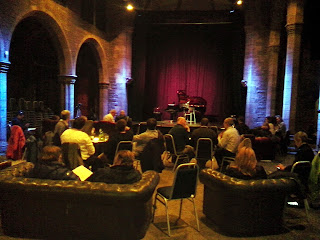
Two extremely bloodthirsty families are at odds in Titus Andronicus which the Grads have just presented. I suppose the play could be considered as a 16th century precursor of Hammer horror movies and treated on that level it's quite fun but I think Shakespeare was wise to abandon the genre and move on to much more interesting stuff.
It was done in the round in what's a new venue for us, Assembly Roxy. It's a great space and the staging in the desert was excellent. ( It took two hours for a substantial team of which I was a puny member to move that sand out on Saturday night.) In general I enjoyed the show, all the cast were convincing and some performances such as SJ's Lavinia who is beaten, raped, has her hands cut off and her tongue torn out were truly excellent. But what a lot of tosh.


Sunday, May 03, 2015
Minimalist music is not everyone's cup of tea but I'm a fan so went hotfoot to The Royal Concert Hall in Glasgow this weekend to enjoy a plethora of fascinating pieces from Steve Reich's monumental Music for 18 Musicians that runs non stop for an hour and demands super competent players to the same composer's Clapping Music, a five minute piece for two but which was performed by a group of school children on this occasion.
I didn't make it on Friday to hear Philip Glass's big concert nor did I grace the midnight to three art college gig and I gave the three hour Sunday morning session for kids a body swerve but I still managed to hear about ten hours of music plus a very entertaining session with Reich in conversation with Colin Currie.
It was not the first time I'd set foot in the concert hall building but it was the first time I'd attended an event there. The auditorium is splendid and there were plenty of other good spaces for the free concerts that took place in the afternoons and for Saturday night when the RSNO were also in action in the building.
It was the first time I'd heard any of this music live with the possible exception of Chasing Sheep is Best Left to Shepherds which I think Michael Nyman's band played on a visit to Edinburgh a long time ago. It confirmed my conviction that recorded music is a poor second best to live performance.
Hard to pick a favourite from around twenty-five disparate pieces but maybe Horses of Instruction by Steve Martland did it for me. But I'd happily hear them all again.
During a break on Saturday I popped round to see the Theatre Royal's new front door and foyer. It's very smart and there's a lovely staircase spiralling its way heavenwards that I couldn't resist snapping.
 There are a number of displays in the foyer including a wonderful video that compresses the two day set up of an opera into two minutes and fifty five seconds by running at breakneck speed. Here are a few stills from it.


I didn't make it on Friday to hear Philip Glass's big concert nor did I grace the midnight to three art college gig and I gave the three hour Sunday morning session for kids a body swerve but I still managed to hear about ten hours of music plus a very entertaining session with Reich in conversation with Colin Currie.
It was not the first time I'd set foot in the concert hall building but it was the first time I'd attended an event there. The auditorium is splendid and there were plenty of other good spaces for the free concerts that took place in the afternoons and for Saturday night when the RSNO were also in action in the building.
It was the first time I'd heard any of this music live with the possible exception of Chasing Sheep is Best Left to Shepherds which I think Michael Nyman's band played on a visit to Edinburgh a long time ago. It confirmed my conviction that recorded music is a poor second best to live performance.
Hard to pick a favourite from around twenty-five disparate pieces but maybe Horses of Instruction by Steve Martland did it for me. But I'd happily hear them all again.
During a break on Saturday I popped round to see the Theatre Royal's new front door and foyer. It's very smart and there's a lovely staircase spiralling its way heavenwards that I couldn't resist snapping.
Subscribe to:
Posts (Atom)
